Bias‑X
A component-level-modeled tube preamp. Cascaded triode gain stages, a real grid-bias point, interstage coupling with dynamic bias-shift, supply sag under drive, and transformer saturation — wrapped in a precise, modern control surface reading its own live DSP state.
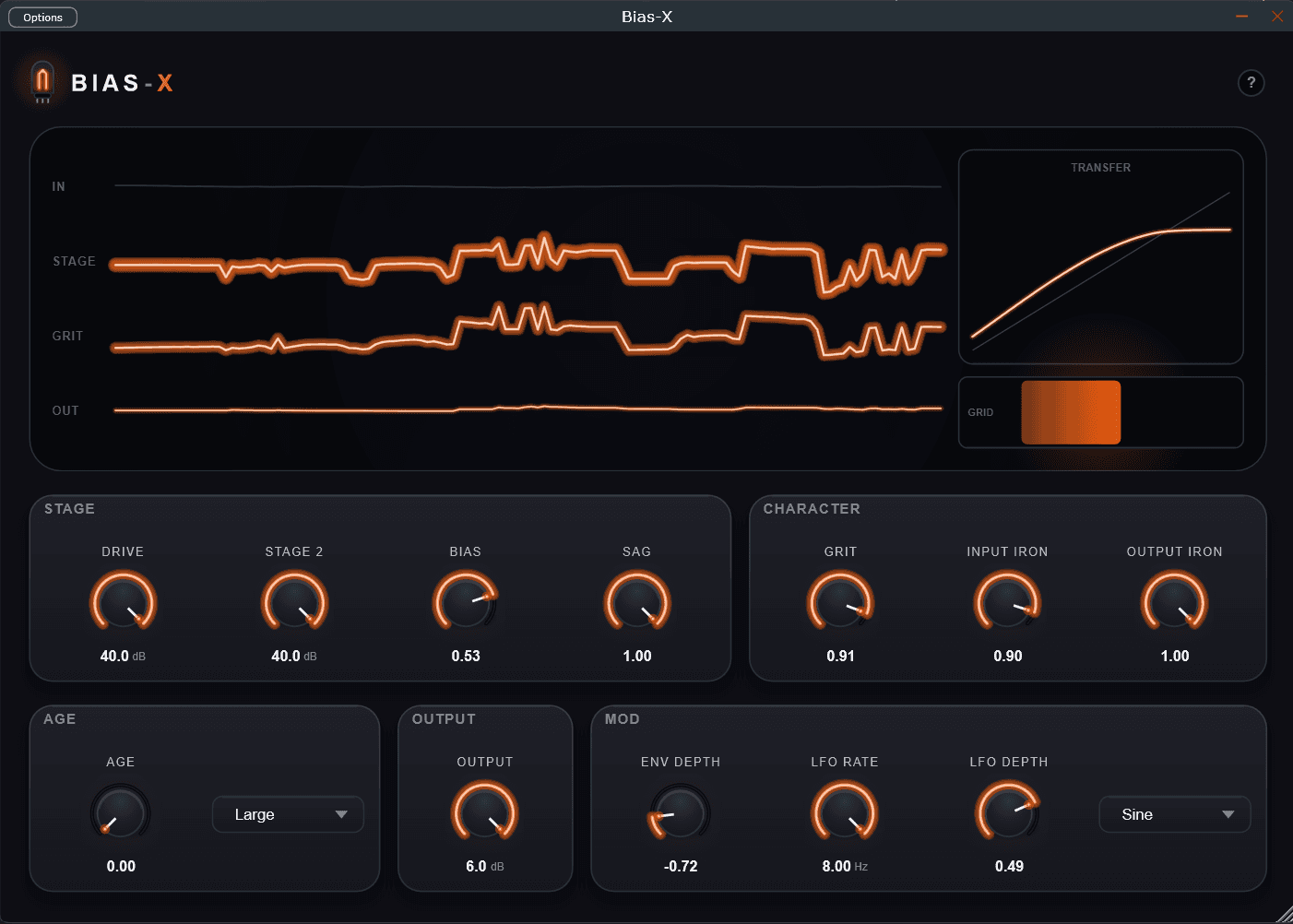
What is the signal-path visualizer?
Bias‑X’s hero display reads the actual DSP state live — four waveform lanes from input through output, a transfer-curve plot pulled from the same math the audio thread runs, and a heat-ramp meter that glows hotter as the tube is driven harder.
Five control groups, ten knobs
Stage
Drive · Stage 2 · Bias · Sag
Two cascaded gain stages, a real grid-bias point, and supply sag under drive — the core of the tube's response.
Character
Grit · Input Iron · Output Iron
Asymmetric pentode clipping plus independent input/output transformer saturation.
Age
Age · Capacitance
Capacitor-aging coloration across three capacitance sizes, from tight and modern to loose and worn.
Output
Output
Final output trim.
Mod
Env Depth · LFO Rate · LFO Depth · LFO Shape
An envelope follower and a free-running LFO — four shapes — for movement over time.
System requirements
- Format
- VST3, Standalone
- Platform
- Windows
- macOS
- In progress
- Verified
- pluginval strictness 10
Changelog
- 0.2.3
Added an About pop-over with credits and a live link back to vst.tools.
- 0.2.2
New glowing-tube header brandmark; knob labels rebalanced; an overload heat cue added to the signal visualizer so a too-hot setting is unmistakable at a glance.
- 0.2.1
Rebranded to Bias-X with its own distinct plugin identity, live-vector header logo.
- 0.2.0
UI reskinned to “Dark Glass / Blaze” — the signature hot-orange accent, an elevated knob finish, and a heat-ramp activity meter.
- 0.1.0
Initial release: full component-level tube-preamp DSP and the signal-path visualizer.